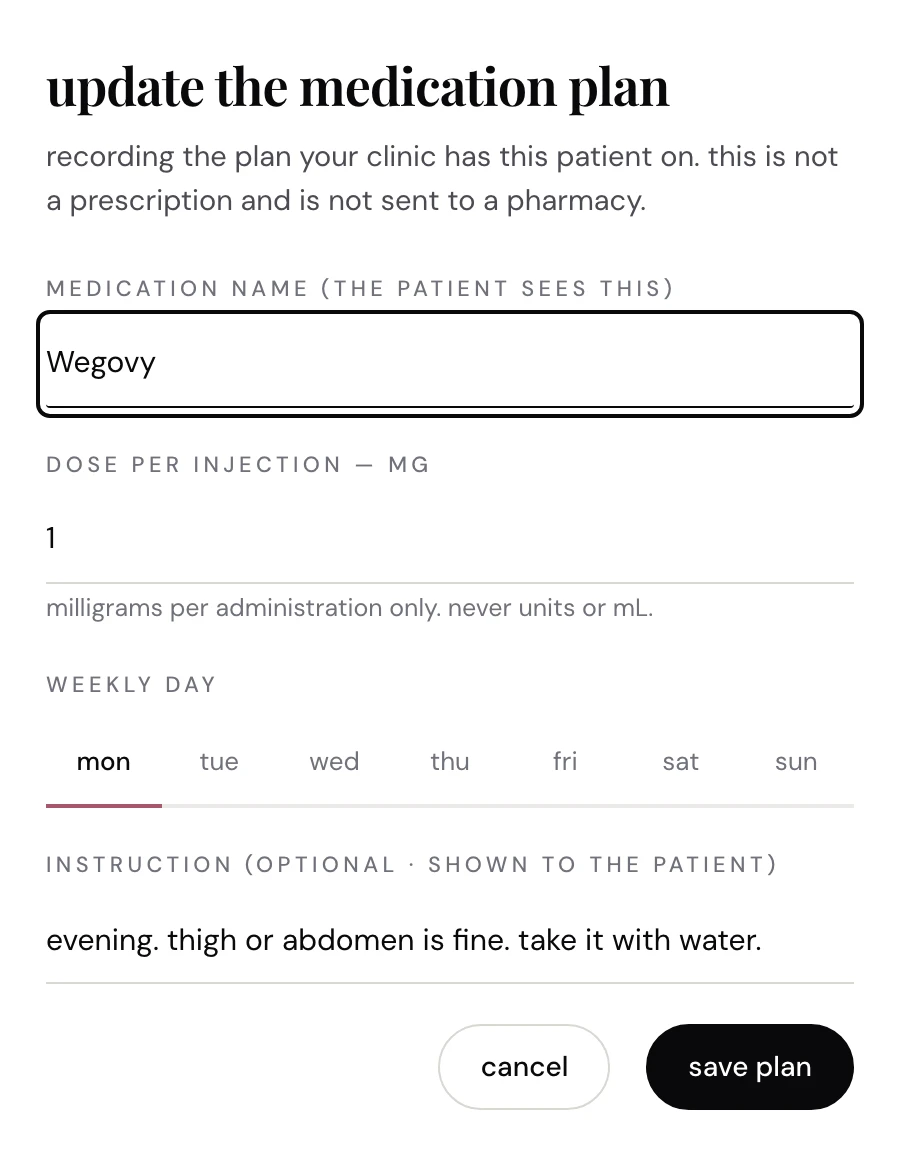
The form a clinic records a medication plan in: name, milligrams per administration, weekly day, and one instruction
02The platform

What it is, part by part.

Two applications and one record between them. The clinic writes the plan; the patient’s own app carries it into their day; what they record comes back for you to read before the next visit. Nothing else moves.

Authorship

Four things, each with a signature.

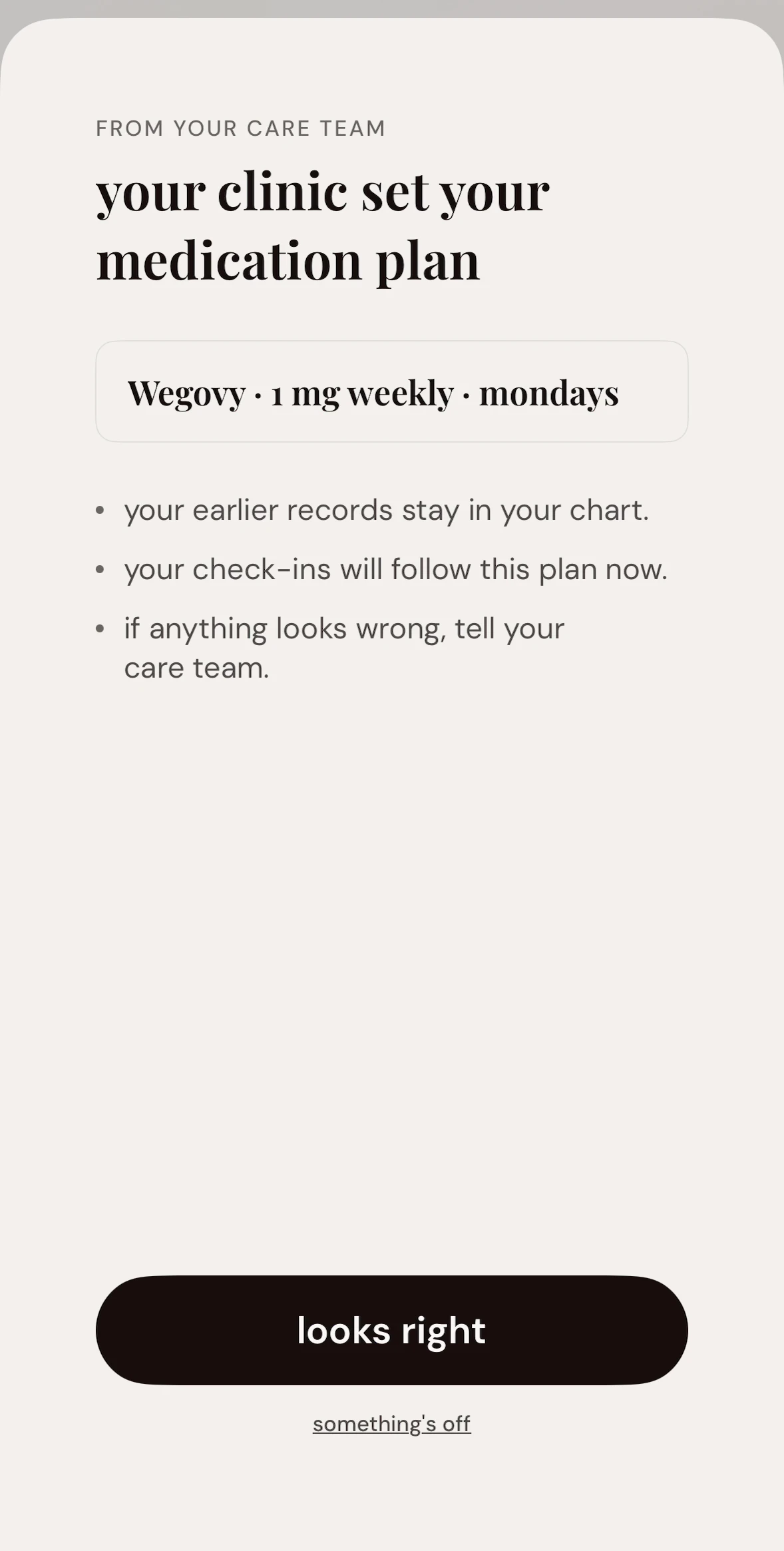
What that form becomes: the plan on the patient's phone, attributed to their clinic, with two answers underneath
The far end of the same act. The clinic's four fields, on the patient's phone, with their name on it.

A clinic does not configure Jeni so much as record, in one place, what it has already decided for this patient. Everything below is authored by a named clinician and reaches the patient carrying that attribution.

The medication planName, milligrams per administration, one weekly anchor day, and one instruction of 140 characters or fewer that the patient reads. Milligrams only; the field refuses units and mL. It records the plan your clinic has this patient on; it is not a prescription and is not transmitted to a pharmacy.
The protocolThe approved plan the patient's app composes their day from, versioned, so that a year later it is still answerable which version a given patient was running.
Three prescribed settingsDaily step goal, weigh-in rhythm, and when the walk is offered. A prescribed setting outranks the patient's own while it stands; releasing it hands the setting back to whatever they had chosen. No history is ever rewritten.
And nothing elseThere is no free-text channel from the clinic to the patient, no message queue, and no assistant answering in your name. That 140-character instruction is the whole of what you can say to a patient through Jeni. It is a small surface on purpose: everything on it is something you wrote.
The record

Only what the patient entered.

Jeni holds no measurement of its own. Every line on the clinician’s page is something the patient recorded on their phone, inside the window their consent allows, and it is labeled as theirs.

Doses, against the schedule you setMarked taken on the day. A scheduled day with no mark is shown as unrecorded, never as skipped. The product refuses to collapse that distinction, because one of them is a fact and the other is an accusation.
How the meals satQueasy, heavy, food noise, counted over the window and placed against the dose days.
Protein against the floor you setLogged days, and how many of them reached the target. In a year where lean-mass preservation is the conversation, it is the number no clinic can currently see.
Weight and movementWeigh-ins at whatever rhythm is set, steps and days moved. Nothing depends on a wearable.
Decisions

It orders. It does not interpret.

The ranked list: a reported problem first, then an overdue follow-up, then a pattern, each with how long it has waited
The ranking, and how long each has waited. That is the whole of the automation on the clinic's side.

This is the first thing clinicians ask about, so it should be the thing stated most plainly.

It decides what needs a readA correction the patient filed against the plan on file, a follow-up past its date, a pattern in the record. That ranking, and how long each has waited, is the whole of the automation on the clinician's side.
It states timing, never cause“Queasy 3×, often within two days of a marked dose” is a statement about dates. It is deliberately not a statement about the medicine, and there is no wording in the product that makes one.
It decides nothing about the medicineNot the dose, not whether to continue, not whether a symptom is serious. Those are not the difficult things to automate. They are the things that must not be.
No model reads your pageThe interval read is computed from the record, deterministically, on the patient's own device. There is no inference sitting between what they entered and what you see.
What it is not

The list that makes the rest believable.

Every item here is a thing a reasonable person assumes a product like this does. None of them is true today, and you should hear it from us rather than find it in a demo.

Nothing notices silenceRecords move only when the patient opens the app. Nothing notices a patient who stops logging, nothing alerts, and nothing is followed up automatically. Jeni is an instrument you read before a visit, and the product says so to the patient as well.
Not a message channelThere is no clinic-to-patient messaging, and no patient-facing assistant answering questions from your protocol. If a patient needs an answer, they contact your practice the way they already do.
It does not replace your chartThere is no e-prescribing. The prescription lives in your EHR and your pharmacy; what is here is the plan your clinic recorded and the patient's own record of following it.
Not a deviceIt does not diagnose, does not recommend a dose, and makes no clinical determination. A design constraint, not a regulatory posture we would quietly revisit once there was revenue to protect.
Enrollment

A code, handed across the desk.

Your clinic mints a one-time code for a named patient. They enter it in the Jeni app and choose, scope by scope, what your clinic may see. No list of your patients leaves the practice, there is nothing for your staff to install, and the patient can end the connection from their phone at any time.

Consent is per clinic and scopedAssigning care, daily records and the visit packet are three separate permissions, held from a stated date forward, so a clinic sees the window the patient allowed and no further back. Connecting by code currently grants the three together; separating them at the moment of asking is on the list before a first real patient.
An audit row on every accessEvery open and every change is recorded, and the patient sees the same trail about their own record that you do. It is the same list, not a redacted one.
iOS todayThe patient app is iOS only. Android is a question we ask on a call, not a date we have.
Integration

No integration, on purpose.

There is no record-system integration today, and a practice can begin without involving anyone else. That is deliberate: bidirectional integration with every chart in the segment is the fastest route for a young company to become an integrations consultancy that also ships some software.

The useful question is which fields you would actually want written back, and to whom. We do not know yet, and the clinics we are talking to this month are how we find out.

What the record is eventually for is set out on the evidence page, including the part where we say no randomized trial has shown that between-visit support raises long-term persistence, ours included.

Talk to us

Read it against your own Tuesday.

Twenty minutes, with the person who built it. You see the clinic side and the patient's phone side by side and tell us where it would break in your practice.